UXOpen
2025
Polaris: Network Matchmaking
An app that connects early-career professionals with relevant industry mentors through personalized matches.
Overview
Everyone says "network more," but nobody tells you where to start.
Polaris is an app that connects users with relevant industry peers to foster meaningful professional relationships through low-commitment chats. Personalized matchmaking help users meet and foster relationships with like-minded professionals in a low-stakes environment.
Approach
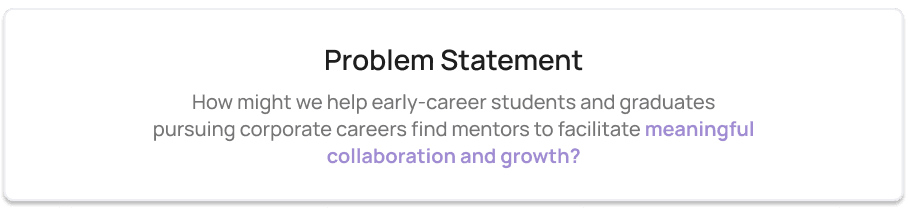
How can we make industry knowledge and networking more accessible, less intimidating, and more interpersonal?
My team consisted of four unemployed students who couldn't land an entry-level internship. This shared frustration is what inspired my team to design a product that would make networking more accessible, and less intimidating.

Research
It's no secret that entry-level positions and internships are more competitive than ever.
Online forums (namely Reddit) highlighted a plethora of negative comments towards the uncertainty of the current entry-level job market.
I asked ChatGPT to verify limitations of traditional networking. Young individuals are interested in fostering genuine connections with mentors, and prefer a low-commitment style of chatting, like social media direct messaging.
Interviews with mentors revealed that senior-level professionals are eager to make knowledge more accessible. Motivations that were cited included developing leadership skills, giving back to their communities, and a desire for genuine connection. Many currently use ADPList to connect with mentees.


Problem
Lo-Fi
Determining what problem we wished to solve was the most difficult part of the entire project.
We were not given a design prompt, which meant we had complete freedom to solve any design problem we desired. However, lack of constraints often lead to indecisiveness. After many conversations (and three FigJams), my team used our initial motivations in participating in the competition (to find a job, of course) to design Polaris.
We were heavily inspired by LinkedIn and dating apps like Hinge. Naturally, designing on a mobile platform allowed for easy accessibility, interpersonal experiences, and immediate notifications when a user is contacted.
With that decision made, we got to work creating wireframes, information architecture, and low fidelity wireframes.


Hi-Fi
Here are two user flows that I designed in Figma.
Click here for the live prototype.
Sign Up
Log In
Reflections
I received overwhelming support from my design mentors from Microsoft, Workday, and Bobatalks.
My greatest takeaway from working on Polaris was how to collaborate with others when you have conflicting ideas. Compromise and learning to experiment with other ideas is crucial for creating the most user-centric design. I also became more familiar with auto-layout and components when designing the app's interface.
Special thanks to our mentors (Matthew Sia, Isanna Wong, and So Eun Ahn) for their constructive feedback, interviews, and overall support towards our project.
And of course, I'd like to thank Isabel Cima, Srilakshmi Akhilan, and Sunny Weng for being the most wonderful, hardworking teammates with exciting ideas and constructive input.
